
Built light.
Forged strong.
A lightweight Debian-based Linux distribution built around Wayland and Labwc, designed to stay fast, simple and out of your way.
Everything you need.
Less of everything you don't.
Most modern distributions bundle gigabytes of background services, indexing daemons, and tightly coupled desktop suites. Iron Linux takes the opposite path: clean Debian foundations, native Wayland protocols, and uncompromising restraint.
Wayland-First & Labwc
Built strictly around Labwc (wlroots) and layer-shell. No legacy X11 daemons or heavy compositor dependencies.
Pure Debian Ecosystem
100% Debian binary compatibility. Normal apt and .deb packages install seamlessly with zero proprietary silos.
Zero Desktop Bloat
No GNOME, KDE, or XFCE middleware running in the background. Idle RAM usage stays lean, reserving your CPU for actual work.
Direct Hardware Control
WirePlumber for audio, NetworkManager in the tray, and Calamares installer for simple, non-destructive partition setups.
Your computer. Without the clutter.
Explore the genuine Iron Linux interface components. Every screenshot is captured directly from the live boot session.
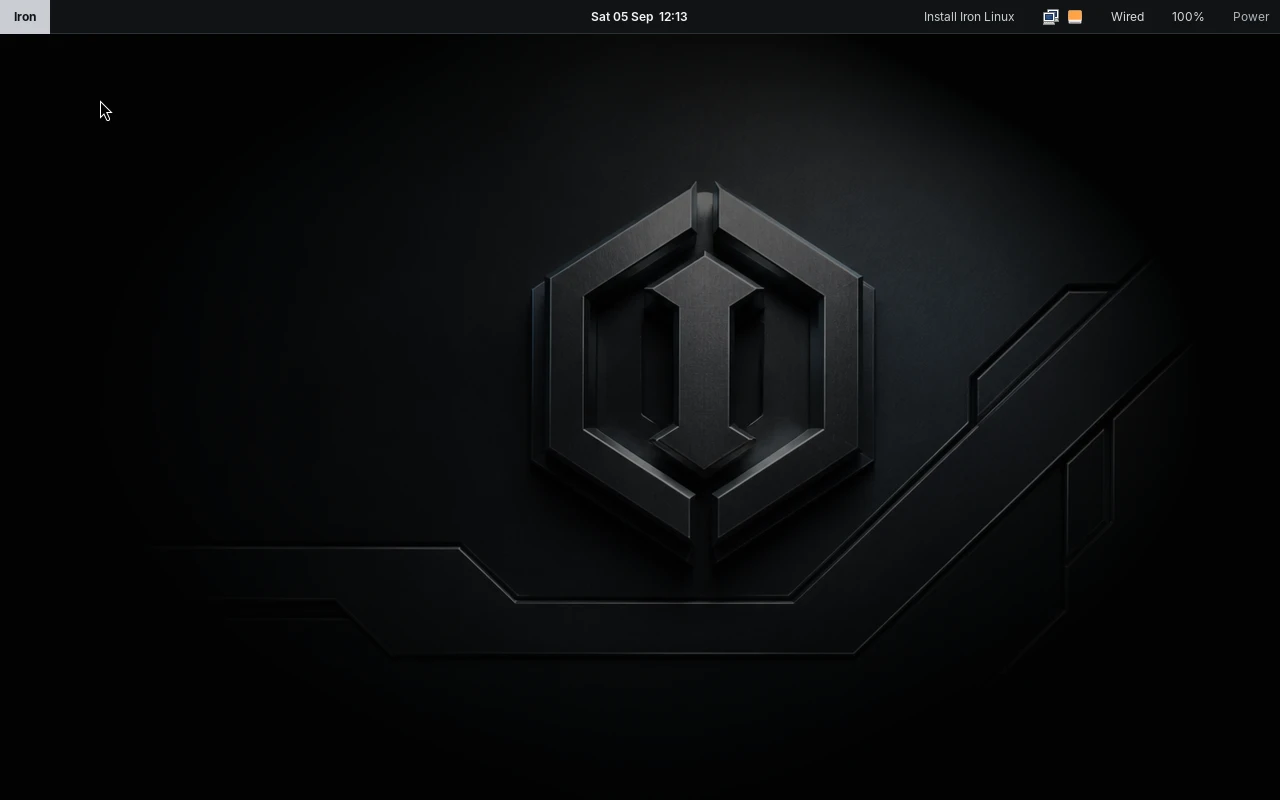
Minimal Labwc Session
A distraction-free stacking compositor built on wlroots. Features a custom Waybar panel with launcher, workspace switcher, clock, system tray, NetworkManager applet, WirePlumber audio, and power controls.
Engineered with precision.
A transparent, layered architecture. No custom daemons or obscure forks: just high-performance native Wayland software atop upstream Debian.
Iron Linux Userland & Brand
// Orchestrated Desktop SessionCurated Waybar top panel, custom Fuzzel launcher, Foot terminal, GTK-CSS graphite themes, Plymouth splash, and Calamares installer integration.
Labwc Compositor Layer
// wlroots Stacking Window ManagerLightweight wlroots-based compositor modelled on Openbox principles. Delivers server-side window decorations, minimal latency, and zero bundled daemon overhead.
Wayland & Hardware Acceleration
// Direct Graphic PipelineModern graphic primitives via Mesa DRM/KMS, PipeWire + WirePlumber audio pipeline, and NetworkManager system tray connectivity.
Debian 13 (Trixie) Base
// Kernel, Corelibs & SystemdRock-solid Debian base using Linux Kernel 6.12, systemd-logind for clean seat management, and Debian live-boot tooling for hybrid media.
APT & .deb Ecosystem
// Official Debian RepositoriesZero custom or proprietary package mirrors. Standard Debian main, contrib, non-free, and non-free-firmware repos ensure transparent and predictable security updates.
Less overhead.
More machine.
Distributions don't become light by accident. They stay light when you refuse to install desktop environment frameworks that register hundreds of background background listeners.
Standalone Single-Purpose Tools
PCManFM handles files without GVFS. Mousepad edits text without GNOME. Xarchiver extracts archives without file-roller dependencies.
Zero Indexing Daemons
No disk-thrashing background indexers (tracker-miner, baloo) waking up your CPU and draining your laptop battery.
Native Wayland Compositing
Direct DRM/KMS hardware rendering bypasses legacy X11 display server hops, giving instant input responsiveness.
GNOME / KDE daemons, gvfs, tracker, polkit plugins, telemetry
Labwc, Waybar, Mako, WirePlumber, NetworkManager applet
Tested platforms & hardware.
We report hardware readiness based on verifiable build and runtime tests, not speculative marketing claims.
x86-64 PC & Laptop
Intel Core / AMD Ryzen modern & legacy systems
- Hybrid BIOS & UEFI El Torito boot
- KMS / Mesa graphics acceleration
- NetworkManager Wi-Fi & Ethernet
- PipeWire audio & WirePlumber
- Calamares automated disk partitioning
Virtual Machines
QEMU/KVM with virtio devices, BIOS & UEFI
- End-to-end boot to graphical login
- virtio-net network driver
- virtio-blk / virtio-scsi disk installs
- SPICE / QXL display & VirtIO GPU
- Reboot from installed qcow2 virtual disk
Raspberry Pi 4
Raspberry Pi 4 Model B (4GB / 8GB)
- Linux Kernel 6.12 aarch64 & DTB staging
- VC4 KMS GPU driver (dtoverlay=vc4-kms-v3d)
- Automated rootfs expansion on first boot
- Onboard Gigabit Ethernet & USB 3.0
- Headless serial & HDMI console
Iron Linux.
Now on ARM.
Dedicated flashable image for Raspberry Pi 4 Model B. Featuring Linux Kernel 6.12 aarch64, VC4 KMS hardware-accelerated graphics, and automated first-boot rootfs expansion.
Four steps to bare metal.
No complex pre-configuration or multi-stage installer wizards.
Download
Grab the verified AMD64 ISO (1.4 GB) or ARM64 Pi image (1.7 GB xz) and verify the SHA-256 hash.
Flash
Write to a USB thumbdrive or microSD card using dd, balenaEtcher, or Raspberry Pi Imager.
Boot
Boot live via BIOS or UEFI. Log into the test desktop using username iron and password live.
Install
Launch the Calamares installer from Waybar or desktop to deploy a permanent installation in under 5 minutes.
Built in the open.
Every package list, hook script, and build flag is publicly audited and version controlled. Built cleanly with Debian live-build.